
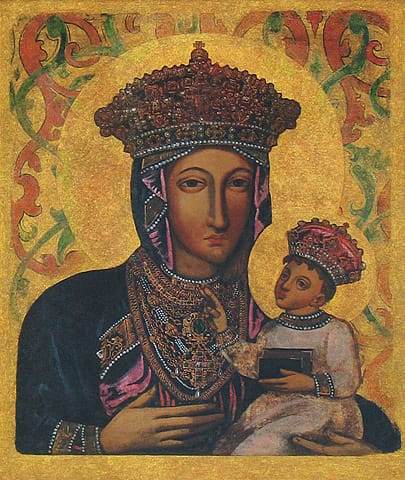
The Miraculous Painting of the Holy Virgin Mary
On August 25, 1670, Aleksas Maceina, sub-guardian of the Franciscan Convent, wrote the following about what was then the most famous image of Mary in Kaunas: “I myself, an unworthy servant of the Mother of God, with all my sorrows and sufferings, with troubles both spiritual and physical, and all kinds of my needs, have especially experienced mercy and grace, (…), offering myself to the Most Pure and Faithful Virgin Mary in this painting.”
This painting of the Mother of God from the Church of St. George the Martyr disappeared from public view for a long time following the church’s closure in 1950, returning to the altar—this time in the Archcathedral Basilica—only in 2001. To uncover the mysterious history of the painting, one must first explore when, where, and how the lost artwork was discovered and subsequently identified.
The story of its discovery can be briefly summarized as follows: the painting was found in 1978 by Rev. Canon Algimantas Kajackas. While caring for the artworks of the Church of the Holy Trinity, which had been returned to the faithful in 1978, he began searching for them. Upon learning that after the closure of this church in 1962, most of its artworks were moved to the Church of St. Anthony of Padua, he searched everywhere. Unfortunately, he managed to find only the statue of St. Francis of Assisi from the high altar and a weathered canvas depicting an unknown image of Mary, cast aside without a frame on the basement floor. Framed and restored, this painting of Mary hung in a seminarian’s room at the Kaunas Priest Seminary for a decade.
In 1992–1993, while researching the interior furnishings and decorations of the Church of St. George the Martyr, I was deeply immersed in the archives of the Franciscan Convent; I was particularly interested in the painting of the Blessed Virgin Mary, famous for its graces in this convent’s church. Convinced that such a painting could not have perished, I set out to find it. When asked whether there was any ancient, unusual, or unknown image of Mary at the seminary, Canon Kajackas showed the image discovered back in 1978. Seeing it, I instantly knew that it had finally been found! However, only thorough studies of historical sources, literature, iconography, and the physical artwork allowed for its full identification.
The history of the painting of the Blessed Virgin Mary was reconstructed from handwritten sources. It is mentioned in the Franciscan Convent archives (for the first time in 1669) and, from the early 19th century until the mid-20th century, in the visitation records and inventory descriptions of the Church of St. George the Martyr (last recorded in 1939). The first accounts of this painting were provided by the aforementioned Aleksas Maceina in his 1670 relation: “That image of the Most Holy Mother of God was painted after the model of the miraculous Czestochowa. Who painted it, who donated it to our church, and how long it has been with us, we cannot inquire even from the oldest elders. Before the war with Moscow, that painting of the Most Holy Virgin had its own dedicated chapel in the middle of the church’s brick wall, to the left upon entering the church from the moat.” As mentioned, the chapel was located in the middle of the northern wall, where it may have been installed at the end of the 16th century.
Jeronimas Krišpinas Kiršenšteinas, patron of the Franciscan Convent, had taken the painting of the Most Holy Mother of God along with other most precious items from the monastery to hide them in Raudonė Castle before the 1655 Russian invasion. In 1669, shortly after the third fire, the renovation of the Chapel of the Blessed Virgin Mary began, funded by Oborskis, the land judge of Kaunas; thus, the chapel remained in its original location. Around 1679, upon completion of the renovation work, the painting was returned to the altar. In the mid-18th century, the current entrance to the church was installed at the location of the chapel. Most likely around that same time, the painting of the Mother of God was relocated from the former chapel to the high altar. Its presence there is noted not only in the 1804 visitation record of the Franciscan Church, but also in all subsequent property inventories, ending with the 1861 inventory.
At the end of the 19th century, the painting of Mary was moved from the high altar to the more modest Altar of St. Anne and hung in its second tier. Because the artwork did not fit due to its size, the canvas was trimmed and slightly reduced in size. The 1939 inventory of the Interdiocesan Kaunas Priest Seminary testifies that the painting in question, “clad in metal garments,” remained in the second tier of the Altar of St. Anne. However, it remains a mystery when and how the painting of the Mother of God ended up in the basement of the Church of St. Anthony of Padua.
Following comprehensive restoration, an almost authentic view of the painting was revealed: expressive faces of the Mother of God and the Infant Jesus painted in delicate ochre undertones, crowns embellished with gemstones and pearls, and glowing golden halos around their heads. This painting of the Blessed Virgin Mary belongs to the earliest Byzantine Hodegetria iconographic type. Mary is depicted standing; on her left arm, the Mother of God holds the Child Jesus, who blesses with His right hand and holds the Gospel book in His left. This is a canonical variation of the Hodegetria composition.
Our painting is distinguished by the richness of the jewelry adorning Mary. The abundance of pearls decorating elements of the attire is particularly striking. Yet this abundance is by no means accidental. On one hand, the pearls serve a decorative purpose; on the other, their symbolic language holds greater importance. The symbolic meaning of a pearl enclosed within a shell is associated in Christian art with the Incarnation (the birth of the Word from the Virgin Mary) and Salvation (Mt 13:45–46).
Equally eloquent is the rich composite arrangement of various jewelry pieces adorning Mary’s breast: interspersed among six twisted and linked chains of different weaves are two strands of pearls and gemstones, and one strand of pearls and hollow metal beads. Furthermore, a piece of jewelry featuring a massive emerald—the most beautiful and valuable of all green stones—at the center of the composition immediately draws attention. Beneath it hangs a Greek cross entwined with chains and adorned with precious stones. Most of the jewelry pieces are antique; moreover, they likely depict the ornaments presented to the original Czestochowa icon in the late 16th to the first half of the 17th century. Therefore, such garment decoration as a whole could have originated at the end of the 16th century. In this artwork, the gem-studded crowns adorning the heads of the Mother of God and the Infant Jesus are painted. Overall, the practice of crowning Marian images across Europe became widespread only in the early 17th century. Thus, the Kaunas Franciscan painting, created around the same time, belongs to the group of works following the Icon of Our Lady of Czestochowa that emerged in the late 16th to the first half of the 17th century.
The painting features abundant manifestations of Byzantine art: in the garments, faces, and in the depiction of both the background and figures. The focus of Byzantine aesthetics on light and color as paramount means of artistic and symbolic expression is most perfectly revealed in painting. Byzantine painting is imbued with light, even though no clearly defined light source exists. In Byzantine artworks, this function is performed by a system of gilded backgrounds, halos, and nimbuses (gold being a symbol of unreal, otherworldly light). The smooth, pure glow of gold seemed to transport viewers of that era into another realm of spiritual entities, distant from the earthly world. We observe a similar visual effect in our painting of the Blessed Virgin Mary. Here, too, both the flat gold background (which was originally unornamented) and the golden halos of the heavenly personages symbolize eternal light (in both cases creating a symbolic, otherworldly space). Thus, this Hodegetria composition painted in the early 17th century is characterized by archaic statics, a certain symbolic nature, and convention. On the other hand, the depictions of the Mother of God and the Infant are realistic; as if emerging from an otherworldly space, they exert a profound attraction.
The archives of the Kaunas Franciscan Convent contain the “True and Sincere Relation of Illustrious Persons Concerning the Miraculous Image of the Most Blessed Virgin in Our Church,” meticulously written in 1670 by the aforementioned Franciscan friar Aleksas Maceina. At the outset, he vividly describes an earlier event from 1655: “When Moscow attacked, that painting was taken from Kaunas to Raudonė, to the estate of His Bright Grace Lord Jeronimas Krišpinas Kiršenšteinas, currently the Treasurer of the GDL. In that chapel during service, at the exact hour the Muscovite captured Vilnius, His Grace himself, Her Grace herself, their Graces’ son, and others clearly saw the painting weeping. His Grace himself faithfully attested to this verbally in the presence of many honorable persons, and to me, an unworthy priest, when I visited him in Raudonė. In the year of the Lord, August 25, 1670.” The quoted text demonstrates that the painting of Mary was held in extremely high regard at the time. Prior to the 1655 Russian invasion, Jeronimas Krišpinas Kiršenšteinas had removed this painting, along with other most valuable items from the monastery, to hide them at the Raudonė estate. Furthermore, a detailed list of items returned in 1670 mentions silver rizas (covers) that clad the figures of the Mother of God and the Infant (briefly describing Mary’s dress: sukienka srebrna gladka – smooth silver dress), as well as two crowns and 23 silver votive plaques. These facts—namely the silver covers that protected the painting’s sanctity and attested to its miraculous nature, along with the ex-votos (silver plaques as tokens of devotion)—demonstrate that by the first half of the 17th century, the painting of the Mother of God was held in exceptional veneration, particularly as it possessed its own dedicated chapel.
In 1669, when Sub-guardian Maceina began recording miracles, he entitled the document “Sequuntur Miracula”. The miracles were written in fine manuscript script across nine pages, meticulously recorded until 1676 (with the final entry dated 1706). Most of these document extraordinary healings. For example, in 1670, Lady Agnietė Aleksandra Simanavičienė, having “vowed herself to the Most Holy Virgin in that painting,” recovered and donated a silver plaque. In 1670, through prayers, Lord Mykolas Rudzianskis was delivered from excruciating toothache before Christmas and likewise donated a silver plaque. In 1671, Lady Magdalena, who suffered from a head pain so severe it drove her near madness, “wept before the miraculous painting and experienced no headache thereafter. As a token of gratitude, she donated a small silver head.” These excerpts from the miracle records attest to the profound faith of the people of that era, as well as the enduring tradition of expressing gratitude through ex-votos.
The cult and miraculous nature of the Kaunas Franciscan painting of the Mother of God—which remained in the same church for nearly 350 years—vividly revealed deep devotion to the Blessed Virgin in this image and demonstrated a variety of devotional practices, particularly characteristic of the second half of the 17th and 18th centuries. Moreover, it is the most Byzantine-style painting of the Blessed Virgin Mary with the Infant in Lithuania.
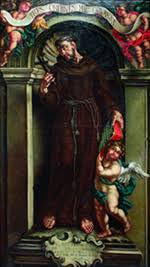
The True Image of St. Francis of Assisi
At the very beginning of the 18th century, the painting of St. Francis of Assisi was installed in an illusionistically painted altar retable on the back wall of the south aisle. In Lithuania, this was one of the earliest works of this type, later repainted in the middle of that century; unfortunately, only faint fragments of both “optical” retables (as they are called in historical sources) survive today. The painting lost its then-modern altar at the end of the 19th century. When neo-Gothic doors leading from the sacristy into the church were installed in that wall, the illusionistically painted retable was not only severely damaged, but also painted over. Consequently, the painting of St. Francis of Assisi was moved to an altar standing by the first pillar; it hung here until 1950, later “wandered” to unknown locations, and since 1971 has been kept at the Kaunas Priest Seminary (currently belonging to the Museum of the Archdiocese of Kaunas).
The early altar iconography of St. Francis of Assisi can be linked to his authentic portraits (in the oldest full-figure portrait, painted around 1222 in the Subiaco monastery, he stands without a halo or stigmata, dressed in a dark habit tied with a cord with three knots—an unknown artist saw Francis as an ascetic and joyful monastic figure). From the 1230s onward, St. Francis began to be depicted standing, full-length, holding a cross in his right hand and a book in his left, with stigmata on his hands and feet, wearing a long habit tied with a cord, barefoot, with a beard and mustache, a tonsure, and a halo around his head.
Artists from Cimabue, Giotto, and Simone Martini, through El Greco, Peter Paul Rubens, and Rembrandt van Rijn up to the present day, have praised St. Francis’s mystical love for Christ’s suffering on the cross in their own ways. In that unbroken line of artists is also the painter Jonas Bielinskis, who worked in the city of Kaunas at the beginning of the 18th century.
The dynamic yet reserved image of the standing St. Francis fills a shallow semicircular niche, reviving a long-cherished tradition of depicting saints, especially in sculpture (for example, Lorenzo Bernini’s statue of St. Bibiana in Rome, 1626). The monk is painted following the previously described iconographic scheme, though with subtle nuances: the habit is brown, and a rosary is attached to the cord (whose three knots symbolize the three monastic vows: poverty, chastity, and obedience). All of Francis’s focus is centered on the Crucified One; this represents a profound love for Christ’s passion, visually expressed here as a silent prayer, an eternal bond—the brightest area of the painting. Only a small angel supporting the heavy book held by the monk gazes directly at us.
In this vivid artwork, there is no sense of external tension; on the contrary, inner energy bursts forth onto the surface primarily through highly contrasting chiaroscuro, especially in the rendering of bodies, where deep dark shadows contrasted with illuminated areas make it “vibrate”. Color accents—the bright draperies of the angels, two of which are rich blue and one a purplish red, repeated with bold brushstrokes in the supported book—form a sort of triangle around the figure of the monk, which, as the foundation of the painting’s structure, highlights an implied diagonal leading toward the center of the composition.
No less important in the painting are the Latin texts harmoniously embedded into its fabric. Two angels wrapped in blue and red draperies hold a banner with the inscription: TRES ORDINES HIC ORDINAT / Founder of Three Orders. On the cover of the book held by St. Francis of Assisi, there is a longer inscription: Rule of the Friars Minor: Brother Francis promises obedience and reverence to the Lord, the Pope, and the Roman Church. Ch. 1. The severely damaged cartouche inscription was illegible in places. In 1992, it was reconstructed by Mindaugas Strockis: The true image of the holy Seraphic brother Francis in a habit of the form permanently established for the Franciscan Order, executed after the one in the Vatican, confirmed by the authority of the Most Illustrious Lord Pope Benedict. Thus, the text of this latter inscription assures us that the altar of St. Francis of Assisi in the Kaunas Franciscan Convent contained what was known as the true image of this saint.
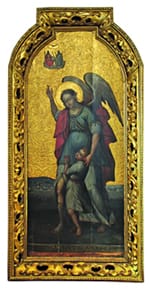
The Painting of the Holy Guardian Angel
In the archives of the Kaunas Franciscan Convent, the boatmen’s (rivermen’s) guild is already mentioned in 1617 as the patron of the Altar of the Holy Guardian Angel in the Church of St. George. Neither the altar nor the painting from that time has survived. It can be assumed that following the fire of 1668, according to the tradition established in the sanctuary, a portion of the altars was rebuilt in their former locations and under the same titles. Most likely, a new Altar of the Holy Guardian Angel was installed in its former location in 1680. Not only has this altar survived (though significantly damaged), but also its original painting ANGELVS. CVSTOS., painted on wooden boards (the artwork remains unrestored to this day).
The painting is signed: on the lower right side, it is meticulously inscribed “Pinxit. Andreas Romanowski.” In this artwork, not only is the figure of the Guardian Angel with a child nestling beside him painted with precision, but also a tiny composition of the Most Holy Trinity high in the sky and a fragment of the city below. In this fragment, we recognize a view of the city of Kaunas at the end of the 17th century. It is the oldest known panorama of this city as viewed from the north across the Neris River. It is exceptionally valuable for the development of Kaunas urban iconography. Furthermore, in this fragment we see recorded the activity of the Kaunas boatmen’s guild: sailboats gliding with the wind along the river, one of which is guided by the Guardian Angel himself—just like the one seen in the painting, only many times smaller here.